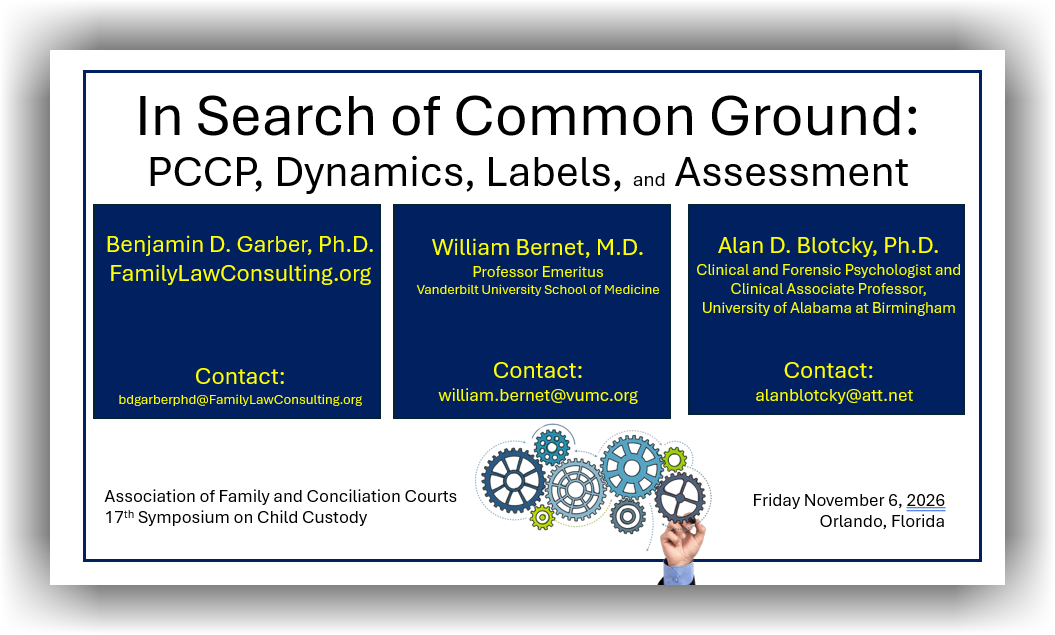
In Search
of Common Ground:
PCCP, Dynamics, Labels, and Assessment
Benjamin
D. Garber, Ph.D.
William Bernet, M.D.
and
Alan D. Blotcky, Ph.D.
Association of Family and Conciliation
Courts
11.06.2026 Orlando, Florida USA
An adversarial collaboration
seeking to clarify how we understand,
evaluate, and therapize
polarized family systems.
Click the image to access
a pdf handout
What is adversarial collaboration?
Championed by
Daniel Kahneman, AC promotes
respectful, constructive
dialogue among professionals who
espouse different hypotheses in
a search for common ground.
Drs. Garber, Bernet, and Blotcky
are each experts concerned with
evaluating, adjudicating, and
therapizing the dynamics of high
conflict families but take
different positions regarding
when and whether and how
"alienation" can and should be
identified and remediated.
Read more about
adversarial collaboration:
Latham, G. P.,
Erez, M., & Locke, E.
A. (1988). Resolving
scientific disputes by the
joint design of crucial
experiments by the
antagonists: Application
to the Erez–Latham dispute
regarding participation in
goal setting. Journal of
Applied Psychology, 73(4),
753–772.
Kahneman,
D. (2003). Experiences
of collaborative
research. American
Psychologist, 58(9),
723–730.
Ceci, S. J.,
Clark, C. J., Jussim, L.,
& Williams, W. M.
(2026). Adversarial
collaboration: An
undervalued approach in
behavioral science.
American Psychologist,
81(3), 374–390.
Specific
to today's discussion:
Amy J.L.
Baker, Reliability and
Validity of the
Four-Factor Model of
Parental Alienation,
42 J. FAM. THERAPY 100
(2018).
Demosthenes Lorandos
& William Bernet
(2020). Parental
Alienation – Science
and Law.
Garber, B.D.
& Simon, R.A.
(2024) Looking Beyond
the Sorting Hat:
Deconstructing the
“Five Factor Model” of
Alienation, Family
Transitions
Baker, A. J.
L. (2020). Parental
alienation and
empirical research. In
D. Lorandos & W.
Bernet (Eds.),
Parental alienation:
Science and law
(p209). Charles C
Thomas Publisher, Ltd.
Bernet, W.,
& Greenhill, L. L.
(2022). The
Five-Factor Model for
the diagnosis of
parental alienation.
Journal of the
American Academy of
Child & Adolescent
Psychiatry, 61(5), p.
592
Garber, B.
D. (2024). A
structured rubric for
evaluating the many
systemic variables
that can contribute to
parent–child contact
problems (PCCP).
Family Court Review,
62(2), 343–358.
Joshi, A.
(2021). Litigating
parental alienation.
American Bar
Association
Herman, S.,
& Freitas, T. R.
(2010). Error rates in
forensic child sexual
abuse evaluations.
Psychological Injury
and Law, 3(2), 133–147
Hershkowitz,
I., Fisher, S., Lamb,
M. E., & Horowitz,
D. (2007). Improving
credibility assessment
in child sexual abuse
allegations: The role
of the NICHD
investigative
interview protocol.
Child Abuse &
Neglect, 31(2),
99–110.
Chaffin, M.,
Lawson, L., Selby, A.,
& Wherry, J. N.
(1997). False
negatives in sexual
abuse interviews:
Preliminary
investigation of a
relationship to
dissociation. Journal
of Child Sexual Abuse,
6(3), 15–29.
Bernet, W.,
& Baker, A. J. L.
(2024). Comments
regarding “Looking
beyond the sorting
hat: Deconstructing
the ‘five factor
model’ of alienation,”
by Garber and Simon.
Family Transitions,
65(1), 32–44.
Emery, R.
(2024). Is the emperor
naked? Questioning the
alienation hypothesis.
Family Transitions,
65(1), 45–48.
Griffin, V.
E. (2024). Building a
better way: A lawyer’s
response to Benjamin
D. Garber and Robert
A. Simon. Family
Transitions, 65(1),
49–64.
Garber, B.
D., & Simon, R. A.
(2024). Moving toward
consensus: Joining
Bernet and Baker,
Emery, and Griffin to
better understand the
dynamics of
parent-child contact
problems (PCCP).
Family Transitions,
65(1), 65–77.
The
information contained in and linked
from this website is generic. It must
not be construed as constituting
legal, psychological, educational, or
medical advice. Decisions relevant to
any specific individual, relationship,
or family should be based on the
considered opinions of professionals
familiar with the unique culture,
resources, strengths, and needs of
those affected.
(c) 2026
Benjamin D. Garber, Ph.D. All rights reserved.